Is Dubai Property a Good Investment in 2026? The Honest Answer
As of October 2026, Dubai apartments earn roughly 6-8% gross rental yield (2025 market data) with no UAE income tax, and prices rose 13% in 2025 — but around 100,000 new units are scheduled for 2026. Good investment for 7-10-year, yield-focused buyers; wrong market for short-term flippers.
Where does the Dubai market stand in October 2026?
As of October 2026, Dubai prices are still rising but decelerating — +13% in 2025 after +18% in 2024 and +22% in 2023 — while gross apartment yields held around 6.8-7% (2025 market data). Roughly 100,000 new units are scheduled for 2026, so the market is shifting from speculation to income.
Dubai residential prices rose about 13% in 2025. Strong — but look at the trend line: +22% in 2023, +18% in 2024, +13% in 2025 (analyst reports, 2025-26). The boom is maturing, not accelerating.
Meanwhile, rents stayed firm. Citywide apartments returned roughly 6.8-7% gross in 2025 (market data, not our projection). That combination — decelerating price growth, solid rents — tells you what this market is becoming: an income market, not a flipping market.
And supply is coming. Around 100,000 units are scheduled for 2026 and roughly 75,000 more for 2027. Historically only about 48% of scheduled units deliver on time, so actual handovers will be lower — but the direction is more inventory, not less.
Seedhi baat: if someone promises you 2023-style capital gains in 2026, walk away. If you want rental income in a zero-income-tax jurisdiction, paid for through a monthly instalment your salary can carry, keep reading — the case is real, and so are the caveats.
The case for buying: what genuinely works
Steel-manning the bull case first, because parts of it are genuinely strong.
- Rental yield. Dubai apartments returned roughly 6-8% gross in 2025 (market data, not our projection). A typical Indian metro flat earns 2-4%. Even after service charges and vacancy pull net down to about 4.5-6%, you are ahead of most Indian residential options — and the rent arrives in a dollar-pegged currency.
- Zero UAE tax on that rent. The UAE levies no personal income tax on rental income and no capital gains tax for individual owners. India-side tax still applies if you are an Indian resident — more on that below, and consult your CA.
- Payment plans your salary can carry. Danube's 1% structure typically means ~10% at booking, then 0.5-1% monthly through construction, often with a post-handover tail — schedules vary per project and tranche. On AED 1M, a 1% instalment is about ₹2.46 lakh (at ₹24.60/AED, Oct 2026, indicative). Compare live schedules on our payment plan tracker.
- Demand has structural legs. The city's population keeps growing, and 2025-26 visa reforms — including the April 2026 removal of the AED 750,000 minimum for Dubai's 2-year investor visa (sole owners) — keep pulling in residents. Residents need flats.
- Your money sits in escrow, not with the developer. Dubai off-plan payments go only into the project's DLD-registered escrow account, released against construction milestones.
- Indians can own outright. 50+ designated freehold zones, full ownership, no local partner, no UAE residency required — and a remote purchase via power of attorney is possible.
The case against: the risks most agents skip
Now the part most brokers mumble through. Read it twice.
- Supply is enormous. About 100,000 units are scheduled for 2026 and ~75,000 for 2027 (analyst reports, 2025-26). Yes, historically only ~48% deliver on time — but delayed supply is still supply. It lands later; it does not vanish.
- And it is concentrated. Roughly 66% of the pipeline is studios and 1-bedroom units, bunched into five districts — including JVC, JVT, Business Bay and Dubailand. If you buy a studio in JVC, your future rental competition is precisely this pipeline.
- Price growth is decelerating. +22% (2023), +18% (2024), +13% (2025). Nobody can tell you where 2026-27 lands. Anyone who claims to know is selling something.
- Currency cuts both ways. The dirham is pegged to the US dollar. If the rupee weakens, your monthly instalment gets heavier in ₹ terms; the same peg means your rent and exit value sit in a hard currency. Price the swing both ways — don't ignore it.
- Remittance friction is real. LRS caps you at USD 250,000 per person per financial year, banks want documentation, and TCS applies above ₹10 lakh (worked example below). None of this is a dealbreaker; all of it is paperwork and cash-flow planning.
- Running costs eat 1.5-2.5 yield points. Annual service charges (billed per sq ft), vacancy between tenants, property management if you are not in Dubai. That is how 7% gross becomes roughly 5% net. Budget for net; celebrate if you do better.
Want a haan-ya-na answer for your budget?
Send your budget and horizon on WhatsApp (10:00-19:00 IST). Developer prices, no buyer-side fee on off-plan — and payments go only to the developer's DLD escrow, never to Ambervista.
WhatsApp the honest checkWhich districts actually deliver the rent?
In 2025 market data, Sports City (7.8-8.3%) and Dubai Silicon Oasis (7.5-8.5%) led gross apartment yields, JVC/JVT returned 7.3-7.8%, Business Bay 6.5-6.9%, against a citywide ~6.8-7%. Net runs 1.5-2.5 points lower after service charges and vacancy — plan on roughly 4.5-6% net.
Yield is a district game, not a city average. The figures below are gross, from 2025 market data — not our projection — and net typically runs 1.5-2.5 points lower after service charges and vacancy.
| District | Gross yield (2025, market data) | Honest caveat |
|---|---|---|
| Dubai citywide (apartments) | ~6.8-7% | The baseline to beat |
| Sports City | 7.8-8.3% | Older stock around you — compete on building quality |
| Dubai Silicon Oasis (DSO) | 7.5-8.5% | Tech-corridor tenant base; watch incoming supply |
| JVC / JVT | 7.3-7.8% | Sits at the top of the studio/1BR supply pipeline |
| Business Bay | 6.5-6.9% | Premium address, thinner yield; also pipeline-heavy |
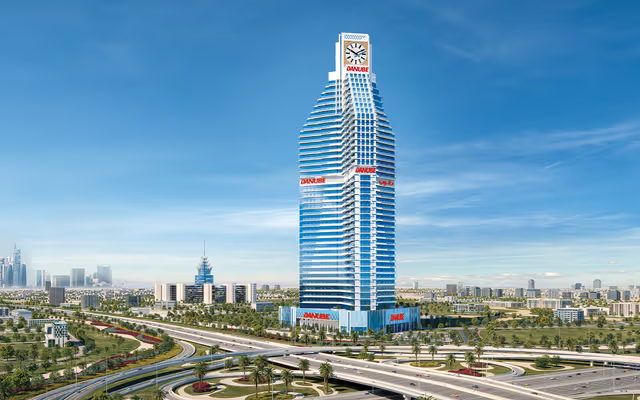
Read this honestly: the high-yield districts are high-yield partly because entry prices are lower — and several sit exactly where the new supply lands. The hedge is to prefer buildings with a real differentiator (views, brand, amenity stack) and handovers that arrive before the thickest supply years. For example, Timez by Danube sits in DSO — the highest-yielding band in the table — with entry at AED 871K (as published by the developer, Oct 2026).
One more point: Business Bay, JVC, JVT, Dubai Marina, Dubai Maritime City, Sports City and DSO — every Danube location — are designated freehold zones, so Indian buyers own outright, no local partner needed.
What does it cost an Indian buyer? A worked ₹ example
Let's price a real scenario: an AED 1M off-plan apartment, converted at ₹24.60 per AED (as of Oct 2026, indicative).
| Item | AED | ≈ ₹ |
|---|---|---|
| Property price | 1,000,000 | ₹2.46 Cr |
| DLD transfer fee (4%) + admin | 40,000+ | ₹9.84 L+ |
| Oqood registration (off-plan) | varies | confirm per project |
| Agent fee (off-plan, direct from developer) | 0 | ₹0 |
| Each 1% monthly instalment | 10,000 | ~₹2.46 L |
On resale property an agent fee of usually 2% applies; on off-plan bought direct from the developer, the buyer pays none.
The remittance route. Under LRS, a resident individual can send USD 250,000 per financial year, cumulative across all banks, and overseas property purchase is a permitted purpose (RBI/FEMA, 2026). Family members who are co-owners on the title can each remit — four co-owners give you roughly USD 1 million of headroom in one financial year. Anything above the cap needs RBI approval.
The TCS correction. Many sites still say TCS starts at ₹7 lakh — that changed on 1 April 2025, when the threshold was raised to ₹10 lakh. The current position: NIL TCS up to ₹10 lakh of LRS remittances per financial year, then 20% on the amount above ₹10 lakh for property remittances, tracked PAN-wise across all your banks under the Income-tax Act. And TCS is not a cost — it is fully claimable as credit in your ITR. It is a cash-flow timing issue, nothing more. Plan the year's remittances with your CA.
For the full step-by-step — bank forms to Oqood — see our guide on how to buy Dubai property from India.
Who should buy — and who should stay out?
Buy if you have a 7-10-year horizon, want roughly 4.5-6% net rental income in a dollar-pegged currency, and can carry a 0.5-1% monthly instalment without stretching. Stay out if you want a 1-3-year flip, your budget is tight, or you expect 2023-style price growth to repeat — growth is decelerating (+13% in 2025).
Haan ya na? It depends entirely on who you are.
Buy if:
- Your horizon is 7-10 years. Supply digestion and currency cycles need time; patient money gets paid.
- You want rental income in a dollar-pegged currency and will be satisfied with roughly 4.5-6% net (gross 6-8%, 2025 market data, minus running costs).
- A UAE residence visa would be genuinely useful to you — as a bonus on top of the investment case, never instead of it.
- The monthly instalment fits inside your surplus without stretching. On AED 1M, budget about ₹2.46 lakh per 1% instalment (₹24.60/AED, Oct 2026, indicative).
Stay out if:
- You want to flip in 1-3 years. Price growth is decelerating and the 2026-27 supply calendar is heavy; a short-term exit may face a crowded resale market.
- Your budget is stretched. A delayed handover — historically only ~48% of scheduled units deliver on time — plus a weak-rupee month should be an annoyance, not a crisis.
- You are buying because a WhatsApp forward said Dubai prices only go up. They do not; no market does.
If you recognise yourself in the second list, genuinely, skip Dubai for now. There is no shame in that answer — and we would rather tell you so on day one.
Does buying get you a UAE visa?
No visa is automatic. Since April 2026, Dubai's 2-year investor visa has no minimum property value for sole owners (joint owners need an AED 400K stake each); the 10-year Golden Visa needs property worth AED 2M or more. You may be eligible, subject to government criteria — confirm the current rules with DLD/GDRFA.
Two property-linked routes exist, and both changed recently — which is exactly why so much online advice is stale.
2-year investor visa (Dubai-specific). Most ranking pages still say you need a property worth AED 750,000. The rule changed in April 2026: DLD removed the minimum property value for sole owners entirely. Joint owners need a stake of at least AED 400,000 each. The property must be freehold residential and DLD-registered, and a mortgaged property needs a bank NOC.
10-year Golden Visa. The threshold is property value of AED 2 million or more; joint owners must each hold a share worth at least AED 2M. Off-plan is generally eligible — practitioner guidance treats the Oqood value as counting. Reports from February-April 2026 indicate the earlier 50%-paid / AED 1M-paid requirement for mortgaged and off-plan cases was eased, but sources conflict on the exact valuation basis for mortgaged units — confirm the current basis with DLD/GDRFA before relying on it.
Our standing advice: you may be eligible for a visa, subject to government criteria at the time you apply. The rules changed twice while competitor pages slept, and they can change again. Treat the visa as a strong bonus, never as the whole case for buying. Full criteria, documents and process: Dubai Golden Visa via property (2026).
Our stance: how we would play 2026
We are a registered Danube channel partner, so discount our enthusiasm accordingly — here is our position anyway, stated plainly so you can hold us to it.
Buy Dubai in 2026 as an affordability-plus-yield play, not a speculation. The payment plan is the real product: 0.5-1% monthly instalments let a working professional build a Dubai asset out of monthly surplus instead of a lump sum, while Dubai's escrow rules keep every dirham in the project's DLD-registered account until construction milestones are met.
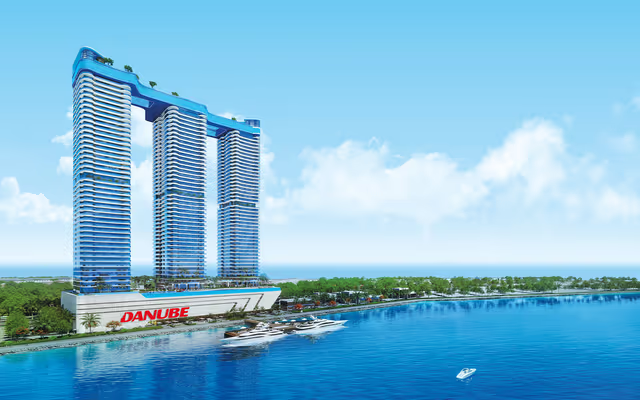
Prefer nearer handovers. The thickest supply lands in 2026-27 on paper, later in practice. A project handing over sooner starts earning rent before the bulk arrives. In the current Danube lineup we would shortlist Oceanz 3 (Dubai Maritime City, from AED 1.2M, handover Q1 2027 — the nearest in the lineup) and Diamondz (JLT, from AED 1.1M, handover Q4 2027) ahead of farther-out towers. Budget entry starts at Timez in Dubai Silicon Oasis from AED 871K. All prices as published by the developer, Oct 2026. Compare every live schedule side by side on our payment plan tracker.
What can still go wrong: your handover slips a year, the rupee weakens mid-plan, or a studio-heavy district softens rents just as you list. Mitigations, not denials: near-handover projects shrink the delay window, a buffer of 3-6 instalments absorbs FX swings, and differentiated buildings rent ahead of commodity stock.
What we never do: we never collect money. Bookings are at developer prices, and payments go only to the developer and the DLD escrow account — never to us. If your profile does not fit, we will say so in the first WhatsApp reply. That costs us a sale and saves our reputation. 10:00-19:00 IST.
FAQs
What net rental yield should I realistically plan for in Dubai?
Gross apartment yields in 2025 market data ran about 6.8-7% citywide, with JVC/JVT at 7.3-7.8%, Sports City at 7.8-8.3% and Dubai Silicon Oasis at 7.5-8.5%. Those are market figures, not our projections. Net is what actually reaches your bank: subtract annual service charges (billed per sq ft), vacancy between tenants and property management if you are not in Dubai, and you typically lose 1.5-2.5 percentage points. So plan on roughly 4.5-6% net. If a broker's spreadsheet shows 9-10% net, ask what was left out — usually service charges and realistic vacancy. We quote the net band up front because disappointed landlords do not send referrals.
Will Dubai property prices fall in 2026?
Honest answer: nobody knows, including us. What the data shows: price growth is decelerating — +22% in 2023, +18% in 2024, +13% in 2025 (analyst reports, 2025-26) — while about 100,000 units are scheduled for 2026 and ~75,000 for 2027, two-thirds of them studios and 1-bedrooms concentrated in five districts including JVC, JVT, Business Bay and Dubailand. Historically only ~48% of scheduled units deliver on time, which spreads the pressure out rather than removing it. Our position follows from that: buy for the payment-plan affordability and the rental yield over a 7-10-year horizon, prefer projects handing over before the bulk of supply, and do not buy anything you need to resell within three years.
How much money can I send from India, and how does TCS work now?
Under the RBI's Liberalised Remittance Scheme, a resident individual can remit USD 250,000 per financial year, cumulative across all banks, and buying overseas property is a permitted purpose (RBI/FEMA, 2026). Family members who are co-owners on the title can each use their own limit — four co-owners create roughly USD 1 million of annual headroom. Above the cap needs prior RBI approval. On TCS, ignore the stale pages still quoting ₹7 lakh: from 1 April 2025 the threshold is ₹10 lakh. NIL up to ₹10 lakh per financial year, then 20% on the amount above it for LRS property remittances, tracked PAN-wise across banks under the Income-tax Act — and fully claimable as credit in your ITR, so it is a cash-flow timing matter, not a cost. Structure the remittance calendar with your CA.
Do I automatically get a UAE visa if I buy property?
No — nothing is automatic. You may be eligible, subject to government criteria at the time you apply. Two routes exist. The 2-year Dubai investor visa: since April 2026, DLD removed the AED 750,000 minimum property value for sole owners (most websites still quote the old figure); joint owners need a stake of at least AED 400,000 each, the property must be freehold residential and DLD-registered, and a mortgaged unit needs a bank NOC. The 10-year Golden Visa: property worth AED 2 million or more, with each joint owner's own share at AED 2M+. Off-plan is generally eligible per practitioner guidance, but the valuation basis for mortgaged units is reported inconsistently in 2026 — confirm the current basis with DLD/GDRFA before relying on it. Treat the visa as a bonus, never as the investment case.
Is off-plan safe? Where does my money actually go?
Dubai's off-plan framework is one of the stricter ones: every payment goes only into the project's DLD-registered escrow account, and the developer can draw funds only against verified construction milestones. Your off-plan interest is recorded through Oqood registration. Ambervista never collects money — bookings happen at developer prices and payments flow to the developer's escrow account, never to us. The realistic risk in Dubai off-plan is therefore delay rather than disappearance: historically only about 48% of scheduled units deliver on time. The practical hedge is choosing projects closer to handover — Oceanz 3, for instance, is slated for Q1 2027, the nearest handover in Danube's current selling lineup — and keeping a buffer of a few instalments so a slipped quarter never becomes a financial crisis.
What are my India-side tax obligations if I buy in Dubai?
Three things, and all of them end with 'consult your CA' because this is general information, not tax advice. One: a foreign property must be disclosed in your ITR under Schedule FA — non-disclosure carries severe penalties under the Black Money Act, so this is non-negotiable. Two: if you are an Indian tax resident, rental income from the Dubai flat is taxable in India, with credit available under the India-UAE DTAA framework; since the UAE levies no personal income tax on rent, in practice the Indian tax applies. NRI positions differ materially. Three: any TCS collected on your remittances is claimable as credit in your ITR. None of this changes the investment case — it changes the paperwork. A one-hour session with a CA who handles foreign assets is the cheapest insurance in this entire process.
Projects this guide points to

Want a haan-ya-na answer for your budget?
Send your budget and horizon on WhatsApp (10:00-19:00 IST). Developer prices, no buyer-side fee on off-plan — and payments go only to the developer's DLD escrow, never to Ambervista.