How to Buy Property in Dubai From India: The Complete 2026 Playbook
Yes — Indian residents can legally buy Dubai property from India under RBI's LRS, remitting up to USD 250,000 per person per financial year (2026 rules). With Danube's monthly plans, entry starts near AED 871,000 (≈ ₹2.14 Cr as of Oct 2026), booking amounts run roughly ₹21–25 lakh, and the purchase can be completed remotely.
Can you legally buy property in Dubai from India?
Yes. Indian residents buy freehold Dubai property outright in 50-plus designated zones — Business Bay, JVC, Dubai Marina, Dubai Silicon Oasis included — with no UAE residency and no local partner. Funds travel under RBI's LRS (USD 250,000 per person per financial year, 2026 rules), and the purchase can be completed remotely via power of attorney.
Dubai has 50-plus designated freehold zones where foreign nationals — Indians included — hold full, permanent title. Business Bay, Jumeirah Village Circle (JVC), Jumeirah Village Triangle, Dubai Marina, Dubai Maritime City, Sports City and Dubai Silicon Oasis are all on the list, and every current Danube location sits in a freehold zone. You own the unit outright: no UAE residency requirement, no local sponsor, no leasehold trap.
On the India side, overseas property purchase is a permitted purpose under RBI's Liberalised Remittance Scheme (LRS). Each resident individual can remit up to USD 250,000 per financial year, counted cumulatively across all your banks (RBI/FEMA rules, 2026). Family members who are co-owners on the title can each use their own limit — more on pooling below, and the full remittance mechanics live in our LRS & TCS guide.
Can't travel? A power of attorney lets a representative complete registration formalities in Dubai, so buyers routinely finish the entire purchase from Indore, Mumbai or Muscat without a single flight. Off-plan booking paperwork is largely digital anyway — passport, PAN and the booking form get most purchases moving. Seedha hisaab: the law is not the barrier. The real work is choosing the right project, the right payment plan, and getting the India-side money mechanics right. That is what the rest of this guide walks through, step by step, with rupee numbers at every stage.
The 7-step process, with ₹ numbers at every step
Here is the whole journey on one AED 1M running example (≈ ₹2.46 Cr at ₹24.60/AED, Oct 2026, indicative).
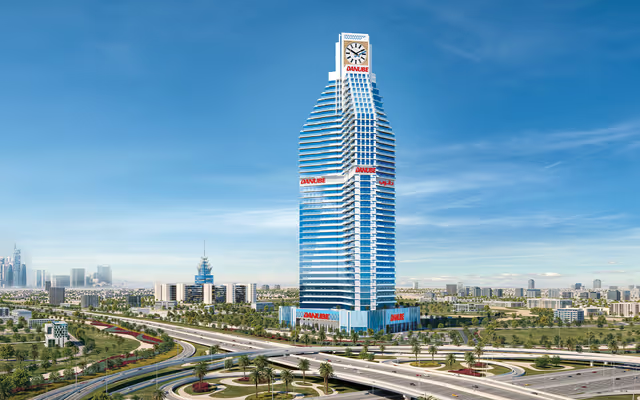
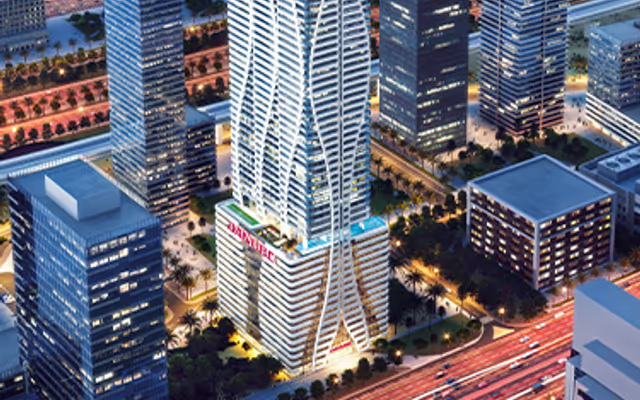
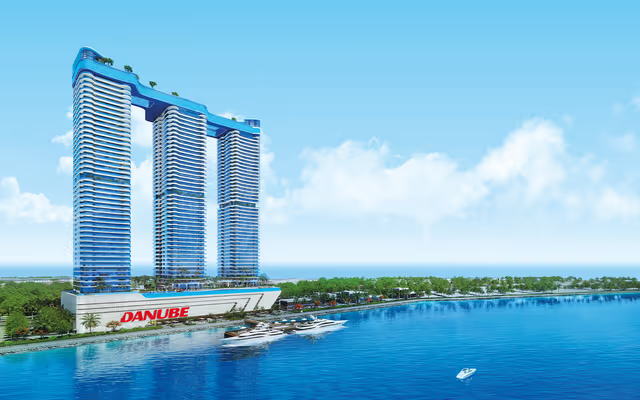
- Choose the project and unit. Entry points as published by Danube, Oct 2026: Timez from AED 871K (≈ ₹2.14 Cr), Bayz 101 from AED 1.175M (≈ ₹2.89 Cr), Oceanz 3 from AED 1.2M (≈ ₹2.95 Cr). Match the plan to your monthly surplus, not just the sticker price.
- Book with the developer. Typically around 10% — AED 100,000 ≈ ₹24.6 lakh on the AED 1M example. It goes to the developer and the project's DLD escrow route, never to a channel partner. Passport and PAN start the file.
- Remit via LRS. Your bank files Form A2 with purpose: purchase of immovable property abroad. Up to USD 250,000 per person per financial year; TCS applies above ₹10 lakh per FY (full math two sections down).
- Oqood and escrow. Off-plan sales are registered with the Dubai Land Department through Oqood, and every dirham you pay goes into the project's DLD-registered escrow account — released to the builder only against certified construction milestones.
- Pay through construction. Danube-style plans run 0.5–1% monthly (occasionally 2%). 1% of AED 1M is AED 10,000 ≈ ₹2.46 lakh a month. Schedules vary per project and tranche — compare them live on our payment plans page.
- Handover. Snagging inspection, balance per your schedule — many Danube plans carry a post-handover tail of roughly 26–35% — and DLD issues the title deed in your name.
- Rent it out. Citywide apartment gross yields ran about 6.8–7% in 2025 market data (not our projection); net is typically 1.5–2.5 points lower after service charges and vacancy. Residents must disclose the asset in ITR Schedule FA and pay Indian tax on rent with DTAA credit — consult your CA.
The full cost sheet: what you actually pay
Budget roughly 5–6% over the property price for Dubai-side costs: the DLD transfer fee is 4% plus admin charges, off-plan adds Oqood registration, and service charges run per square foot annually after handover. Buying off-plan directly from the developer means no agent fee to you; resale usually carries 2% (market practice, 2026).
On the AED 1M example (₹ at ₹24.60/AED, Oct 2026, indicative):
| Item | When | AED on 1M example | ≈ ₹ |
|---|---|---|---|
| Property price | Spread over the payment plan | 1,000,000 | ₹2.46 Cr |
| DLD transfer fee (4%) + admin | Per project schedule | 40,000 + admin | ₹9.84 L + |
| Oqood registration (off-plan) | At booking/registration | Confirm exact fee at booking | — |
| Agent fee, off-plan direct from developer | — | NIL to buyer | ₹0 |
| Agent fee, resale market | At purchase | Usually 2% (market practice) | ~₹4.9 L |
| Service charges | Annually after handover | AED/sq ft, varies by project | Confirm per project |
| TCS, India side (above ₹10L/FY) | At remittance | 20% of amount above ₹10L — claimable as credit in your ITR | Cash-flow, not a cost, if claimed |
Two honest notes. First, TCS is collected tax, not lost money — you adjust it against your Indian tax liability or claim the refund when you file (details in the next section, and consult your CA). Second, service charges are the line most first-time buyers forget: they are charged per square foot every year and directly decide whether your gross yield of 6–8% becomes a net 4.5–6% or worse (2025 market bands, gross, not our projection). Ask for the current service-charge rate of the specific tower before you book — we share it on WhatsApp for any project on our comparison page.
Ready to run your numbers?
Tell us your budget in ₹ and your monthly comfort — we'll send 2–3 matching Danube options at developer prices, with the full cost sheet including TCS and DLD fees. No charge to you, ever. 10:00–19:00 IST.
Chat on WhatsAppLRS, TCS and family pooling — the India-side money mechanics
LRS allows USD 250,000 per resident individual per financial year, cumulative across banks, and overseas property is a permitted purpose (RBI/FEMA, 2026). TCS is NIL up to ₹10 lakh per FY and 20% on the amount above it — fully claimable as credit in your ITR. Co-owner family members can each remit their own USD 250,000.
Correction worth money: many sites still say TCS starts at ₹7 lakh. The rule changed on 1 April 2025 — the threshold was raised to ₹10 lakh per financial year. Above ₹10 lakh, banks collect 20% TCS on LRS property remittances, tracked PAN-wise across all your banks. From April 2026 the TCS provisions sit under the new Income-tax Act — the mechanics are the same, but consult your CA for your specific filing.
Worked example: you remit ₹60 lakh this FY towards instalments. First ₹10 lakh — no TCS. On the remaining ₹50 lakh, the bank collects 20% = ₹10 lakh. That ₹10 lakh appears in your Form 26AS and is fully adjustable against your tax liability — or refunded — when you file your ITR. It is a cash-flow cost, not an expense. Plan for it so an instalment never bounces.
Family pooling: the USD 250,000 cap is per person, per financial year. If a unit is bought jointly, each co-owner on the title can remit under their own limit — a family of four can legally move up to USD 1 million in one FY. Anything beyond the cap needs prior RBI approval, which is rare in practice. A single person's annual limit comfortably covers the booking plus a year of 1% instalments on most Danube entry units. Full worked scenarios, bank-by-bank quirks and the Schedule FA disclosure checklist are in our dedicated LRS & TCS guide.
Payment plans: how 0.5–1% monthly actually works
The reason Dubai works for salaried and business buyers from India is not magic pricing — it is the structure. Danube's trademark plan is typically about 10% at booking, then 0.5–1% of the price every month through construction (some tranches 2%), often with a post-handover tail of roughly 26–35%. No home loan, no interest, no Indian bank approval — your instalment goes straight into the project's DLD escrow. Schedules genuinely vary per project and tranche, so always read the specific plan, not the headline.
Current entry points, as published by the developer, Oct 2026 (₹ at ₹24.60/AED, indicative):
| Project | Entry price (AED) | ≈ ₹ | ~1%/month in ₹ |
|---|---|---|---|
| Timez, Dubai Silicon Oasis | 871K | ₹2.14 Cr | ~₹2.14 L |
| Sparklz | 900K | ₹2.21 Cr | ~₹2.21 L |
| Bayz 101, Business Bay | 1.175M | ₹2.89 Cr | ~₹2.89 L |
| Oceanz 3, Maritime City | 1.2M | ₹2.95 Cr | ~₹2.95 L |
| Breez | 1.25M | ₹3.08 Cr | ~₹3.08 L |
Oceanz 3 is the nearest handover on our list — Q1 2027 — which matters more than most buyers realise (see the oversupply section below for why). Every live schedule, side by side, with booking amounts in rupees: our payment-plan comparison.
Visas: what a property can and cannot get you
Property owners may be eligible for UAE residence visas, subject to government criteria at the time of application. As of April 2026, Dubai's 2-year investor visa has no minimum property value for sole owners (joint owners need an AED 400K stake each), and the 10-year Golden Visa requires property worth AED 2 million or more. Confirm current rules with DLD/GDRFA.
Another place where most ranking pages are stale. In April 2026, the Dubai Land Department removed the AED 750,000 minimum for the 2-year investor visa for sole owners — there is now no minimum property value, provided the property is freehold residential and DLD-registered. Joint owners need a stake of at least AED 400K each (≈ ₹98.4 lakh at Oct 2026 rates), and mortgaged properties need a bank NOC. Many sites still quote the old AED 750K floor — the rule changed in April 2026, and it is Dubai-specific.
The 10-year Golden Visa needs property value of AED 2 million or more (≈ ₹4.92 Cr). Off-plan is generally eligible — the Oqood value counts, per practitioner guidance. Reports from February–April 2026 indicate the earlier requirement of 50% paid / AED 1M paid for mortgaged and off-plan properties was eased, but published sources conflict on the exact valuation basis for mortgaged units — confirm the current basis with DLD/GDRFA before relying on it. Joint owners qualify only if their own share is AED 2M or more.
Our honest framing: never buy a property primarily for a visa. You may be eligible for a residence visa, subject to government criteria that can change — treat it as a bonus on a purchase that already makes sense on price, plan and yield. Which Danube units cross the AED 2M line, and the document trail for an application, are covered in our Golden Visa property guide. Projects like Bayz 101 have higher-floor units that cross the threshold; entry-level studios do not.
What can go wrong — the honest list
If a page selling you Dubai property has no section like this, close the tab. Four real risks:
- Delays. Analyst data from 2025–26 shows only about 48% of Dubai's announced pipeline has historically delivered on time. Escrow protects your money, not your timeline. We prefer nearer-handover projects — Oceanz 3 at Q1 2027 over a 2029 tower — precisely for this reason.
- Oversupply in specific segments. Around 100K units are scheduled for 2026 and about 75K for 2027, and the pipeline is roughly 66% studios and 1BRs concentrated in five districts, including JVC/JVT, Business Bay and Dubailand (analyst reports, 2025–26). Translation: the exact segment most Indians buy is the crowded one. Rental demand is real, but assume competition on rents and resale in those pockets.
- Price growth is decelerating. Dubai prices rose about 13% in 2025 — but that follows +22% in 2023 and +18% in 2024. The direction is still up; the slope is flattening. Buy for payment-plan affordability and rental yield, not for a quick flip. If your plan only works with 15% annual appreciation, it is not a plan.
- Exchange rate. Your instalments are in dirhams; your income is in rupees. ₹24.60/AED is the Oct 2026 indicative rate — if the rupee weakens, every future instalment costs more in ₹. Spread-out payments soften the blow versus one lump sum, but keep headroom in your monthly budget rather than committing your last rupee.
None of these kill the case for buying. They kill the case for buying blind — which is the difference between an investment and a story someone sold you.
Why the channel-partner route costs you nothing
A fair question: if Amberstone helps you shortlist, runs the rupee math, and coordinates the paperwork, who pays for that? The developer does. As a registered Danube Properties channel partner, we are paid a marketing fee by the developer on completed bookings — the price you pay is the developer's published price, the same as walking into their office in Dubai. Off-plan direct from the developer carries no agent fee to the buyer at all.
Equally important is what we never do: we never collect money. Every payment goes from your bank account to the developer and the project's DLD-registered escrow account — booking amount included. If anyone in this market asks you to transfer money to a personal or agency account, walk away. Your protection is structural: Oqood registration in your name, escrow release only against construction milestones, and a paper trail from your Form A2 to the title deed.
What you get from us: developer-published prices with every cost converted to rupees, the TCS and LRS math done before you commit, side-by-side payment schedules on the comparison page, and a straight answer when a project is wrong for you — see the honesty section above; that is the house style. We work WhatsApp-first, 10:00–19:00 IST, so questions get answered the way you actually ask them: one message at a time, in your own time.
FAQs
Can I complete the entire purchase without flying to Dubai?
Yes, and buyers do it every month. Off-plan booking with a developer like Danube is document-light at the start — passport, PAN and the booking form, mostly handled digitally. Your payments go by bank transfer under LRS from India directly to the developer and the project's DLD escrow account. For registration formalities that need a physical presence in Dubai, a power of attorney lets a representative act for you; many NRI and resident Indian buyers use exactly this route. A site visit is still worth doing if you can — not legally, but because walking the district tells you things brochures will not. If you cannot travel, insist on current construction photos and video walkthroughs, and verify the project's escrow registration with the Dubai Land Department. We coordinate all of this on WhatsApp.
What is the minimum money I need to get started from India?
On current Danube entry pricing (developer-published, Oct 2026), the lowest entry is Timez at AED 871K ≈ ₹2.14 Cr at ₹24.60/AED (indicative). A typical booking of around 10% means roughly ₹21–22 lakh to start, after which 0.5–1% monthly instalments run about ₹1.1–2.1 lakh per month on that unit. Budget separately for the 4% DLD fee (≈ ₹8.6 lakh on Timez's entry price), Oqood registration, and the TCS cash-flow on remittances above ₹10 lakh per financial year — claimable in your ITR, but it leaves your account first. Honest advice: keep headroom. The rupee moving 3–4% against the dirham over a multi-year plan changes your monthly outgo, and the buyers who get into trouble are the ones who committed their entire surplus on day one.
Will I lose 20% of my money to TCS?
No — this is the most misunderstood number in the whole process. TCS is tax collected at source, not a fee. Since 1 April 2025 the threshold is ₹10 lakh per financial year (many sites still quote the old ₹7 lakh figure): remittances up to ₹10 lakh attract no TCS, and above that your bank collects 20% on the excess, tracked against your PAN across all banks. The entire amount shows up in your Form 26AS and is fully adjustable against your income-tax liability when you file your ITR — any excess comes back as a refund. So it is a timing cost, not a real cost. The practical impact is cash-flow planning: on a ₹60 lakh remittance year, about ₹10 lakh sits with the government until your return is processed. From April 2026 these provisions operate under the new Income-tax Act — same mechanics, but consult your CA for your specific situation.
Is my money safe in an off-plan project?
Structurally, Dubai off-plan has strong money protection: payments go only into the project's DLD-registered escrow account, and the developer can draw funds only against certified construction milestones. Your purchase is registered in your name through Oqood. What escrow does not protect is your timeline — analyst data from 2025–26 shows only around 48% of announced projects have historically delivered on time. So the honest risk is delay, not disappearance. Our mitigations: prefer nearer-handover projects (Oceanz 3 at Q1 2027 is the closest on our current list), check the developer's delivery track record rather than its renders, and never pay anyone outside the developer/escrow route — including us. Amberstone never collects money; if any intermediary asks you to transfer to their account, that is your signal to leave.
Will buying a property get me a UAE visa?
You may be eligible for a residence visa, subject to the government's criteria at the time you apply — nobody can promise you a visa, and you should not buy from anyone who does. As of April 2026, Dubai's 2-year investor visa no longer has a minimum property value for sole owners (the old AED 750K floor was removed; joint owners need an AED 400K stake each), for freehold residential, DLD-registered property, with a bank NOC if mortgaged. The 10-year Golden Visa requires property value of AED 2 million or more (≈ ₹4.92 Cr at Oct 2026 rates), with off-plan generally counting at Oqood value per practitioner guidance; for mortgaged and off-plan cases the 2026 easing reports conflict on valuation details, so confirm the current basis with DLD/GDRFA before relying on it. Treat the visa as a possible bonus, never the reason to buy.
I am an NRI, not a resident Indian — does this guide apply to me?
The Dubai side is identical: freehold ownership, escrow, Oqood, payment plans and visa eligibility work the same whichever passport stamp you carry. The India-side money mechanics differ, though. LRS and its USD 250,000 limit apply to resident individuals; NRIs typically fund Dubai purchases from overseas income or NRE/foreign accounts, which sit outside LRS and outside TCS entirely. Tax treatment also differs — for residents, Dubai rental income is taxable in India with DTAA credit and the property must be disclosed in ITR Schedule FA (non-disclosure carries penalties under the Black Money Act); for NRIs the Indian tax picture depends on your residency status for that year. This is exactly the terrain where a one-hour conversation with your CA before booking pays for itself many times over. The project selection and payment-plan logic in this guide applies to everyone.
What happens if the rupee weakens during my payment plan?
Every future instalment costs more in rupees — that is the honest answer, and any page that skips it is not being straight with you. Your contract is in dirhams; ₹24.60/AED is the indicative Oct 2026 rate, not a promise. A monthly-instalment plan actually spreads this risk compared with a lump-sum purchase: you buy dirhams at many different rates over the construction period instead of one, which softens — but does not remove — the impact of a weakening rupee. The flip side is rarely mentioned: your asset and its rental income are also in dirhams, so the same currency movement that raises your instalment cost raises the rupee value of what you own and earn. Practical rule: size your monthly commitment so a meaningfully worse exchange rate is an annoyance, not a crisis, and revisit the math with us on WhatsApp whenever the rate moves sharply.
Projects this guide points to
Ready to run your numbers?
Tell us your budget in ₹ and your monthly comfort — we'll send 2–3 matching Danube options at developer prices, with the full cost sheet including TCS and DLD fees. No charge to you, ever. 10:00–19:00 IST.