The Danube 1% Payment Plan, Explained With Real Numbers
Danube's 1% payment plan splits a Dubai apartment's price into a booking amount (typically around 10%), small monthly instalments through construction, and often a post-handover tail. On Oceanz 3's published 65/35 plan (October 2026), 1% of the AED 1.2M entry price is AED 12,000 — roughly ₹2.95 lakh a month at ₹24.60/AED, indicative.
What exactly is the Danube 1% payment plan?
It is developer-financed instalment buying: you book with roughly 10%, then pay 0.5–2% of the price every month while the tower is built, with 26–35% often left as a post-handover tail. No bank, no interest. Exact splits vary per project and tranche — Oceanz 3's published plan is 65/35 (October 2026).
Danube builds the plan into the price sheet itself. The pattern across current launches: around 10% at booking, then 0.5–1% of the purchase price billed every month while construction runs — some tranches bill 2%. On several projects, a 26–35% chunk is parked after handover, so you keep paying monthly while you already hold the keys.
Two things make this different from a typical builder-subvention scheme in India. First, every dirham you pay on a registered Dubai off-plan project goes into the project's DLD-supervised escrow account — not the developer's general account — and is released only against certified construction milestones. Second, there is no interest meter running. The plan is a schedule, not a loan. You are not borrowing; you are paying the price slowly.
The catch, and it matters: "1%" is a headline, not a contract term. Schedules differ per project, and even per tranche within the same project. Timez's sheet is not Aspirz's sheet, and the sheet you saw in a 2024 YouTube video is almost certainly not the current one. We keep a live side-by-side of every current Danube schedule on our payment plan comparison page — trust that over an old screenshot, and ask us for the dated instalment sheet for your exact unit before you commit anything.
A real worked example: Oceanz 3 at AED 1.2M
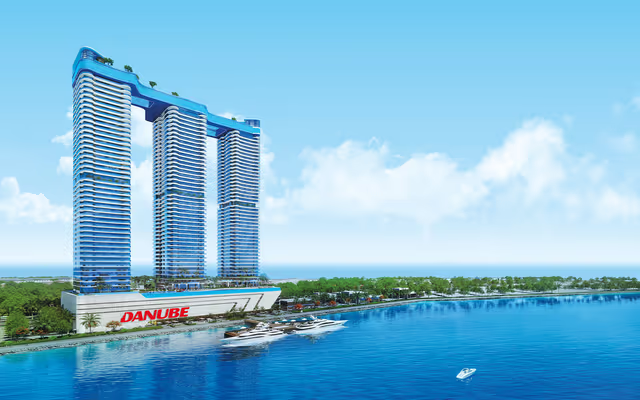
Oceanz 3 at Dubai Maritime City is the cleanest example because it is Danube's nearest handover (expected Q1 2027) and the plan is published: 65% through construction, 35% after handover (developer publication, 3 October 2026). Entry price is AED 1.2M for a studio, as published by the developer, October 2026. At ₹24.60/AED (as of Oct 2026, indicative) that is about ₹2.95 Cr. Here is how the money actually moves:
| Stage | AED | ≈ ₹ (Oct 2026, indicative) |
|---|---|---|
| Booking (typically ~10%) | 120,000 | ₹29.5 lakh |
| Balance through construction (to 65%) | 660,000 | ₹1.62 Cr |
| Post-handover tail (35%) | 420,000 | ₹1.03 Cr |
| One monthly 1% instalment | 12,000 | ₹2.95 lakh |
One honest caveat most pages skip: the gentle ₹2.95-lakh-a-month picture assumes you joined near launch. Oceanz 3 is close to handover now, so a buyer booking today typically clears the construction-linked instalments that have already fallen due as a larger upfront amount, then rides the 35% tail after the keys. The later you join a project, the bigger the catch-up and the shorter the drip. That is not a flaw — near-handover projects carry less construction risk — but the cash-flow shape changes, so ask us for the live instalment sheet mapped to your unit before you compare anything else.
Also budget transaction costs on top: the 4% DLD fee alone is AED 48,000 (≈ ₹11.8 lakh) at this price. Full cost breakdown below.
Entry prices across live Danube projects (October 2026)
Every currently selling Danube project carries a 1%-family plan, but entry tickets and tranche structures differ. Prices below are as published by the developer, October 2026. Rupee figures use ₹24.60/AED (Oct 2026, indicative). All locations are designated freehold zones, so Indian citizens can own outright — no UAE residency, no local partner.
| Project | Area | Entry (AED) | ≈ ₹ | Handover |
|---|---|---|---|---|
| Timez | Dubai Silicon Oasis | 871,000 | ₹2.14 Cr | Q2 2028 |
| Aspirz | Dubai Sports City | 879,000 | ₹2.16 Cr | Q4 2028 |
| Sparklz | Al Furjan | 900,000 | ₹2.21 Cr | Q2 2028 |
| Diamondz | JLT | 1,100,000 | ₹2.71 Cr | Q4 2027 |
| Serenz | JVC | 1,100,000 | ₹2.71 Cr | 2029 |
| Bayz 101 | Business Bay | 1,175,000 | ₹2.89 Cr | Q2 2028 |
| Oceanz 3 | Dubai Maritime City | 1,200,000 | ₹2.95 Cr | Q1 2027 |
| Breez | Dubai Maritime City | 1,250,000 | ₹3.08 Cr | 2029 |
Reading the table like a consultant would: Timez is the lowest ticket and the seedha-hisaab entry point for a first Dubai purchase. Oceanz 3 is the nearest handover, which matters more than most buyers think in the current market (see the oversupply section at the end). Bayz 101 is the Business Bay address — the strongest location on the list on paper, priced accordingly. Tranche-by-tranche schedules for all of these sit on the live payment plan comparison, updated whenever the developer reprints a sheet.
Want the current instalment sheet for your budget?
Tell us your monthly comfort and city preference on WhatsApp — we reply with dated schedules for 2–3 matching Danube projects at developer prices. Payments go only to DLD escrow, never to us. 10:00–19:00 IST.
WhatsApp AmberstoneThe costs the price tag doesn't show
The 1% plan spreads the price, not the transaction costs. Budget these separately, mostly in the first weeks:
- DLD transfer fee: 4% of purchase price, plus small admin charges. On an AED 1.2M unit that is AED 48,000 ≈ ₹11.8 lakh (Oct 2026, indicative). Usually due at booking stage — it does not ride the monthly plan.
- Oqood registration for off-plan: the interim registration that records your unit against your name with DLD before title deed exists. A fixed fee, paid early.
- Service charges after handover: billed annually per square foot and varying by building. This is the line that turns gross rental yield into net yield, so ask for the current rate for your specific tower before running rental math.
- Agent fee: nil to you on off-plan bought direct from the developer. On Dubai resale deals the buyer typically pays around 2%, but on a fresh Danube booking the developer pays the channel partner. You pay the developer's published price — the same price sheet whether you walk in alone or come through us.
On that last point, our standing rule at Amberstone: we never collect money. Every payment goes directly to the developer's DLD-registered project escrow account or to DLD itself, against official payment notices. If anyone — any agency, anywhere — asks you to transfer booking money to their own account for a Dubai off-plan unit, walk away. The escrow system only protects you if your money actually enters it.
1% plan vs home-loan EMI: which is better?
Neither wins outright. The 1% plan charges zero interest but gives zero leverage — you fund the full price from your own pocket during construction years. A home loan costs real interest but lets you control an asset with a fraction of your capital. The honest answer depends on what your capital earns elsewhere.
Every seller pitches "no interest!" and stops there. Here is the full picture:
| Danube 1% plan | Home loan (illustrative) | |
|---|---|---|
| Interest cost | Zero — it's a schedule, not a loan | Real and large over tenure |
| Leverage | None — 100% your capital | High — bank funds the bulk |
| Payment window | Compressed into construction + tail (roughly 3–6 years) | Stretched 15–20 years |
| Credit check / income proof | Not required by a bank | Full underwriting |
| Default consequence | SPA cancellation terms (next section) | Bank recovery process |
Put illustrative numbers on it. A ₹1 Cr home loan at 9% p.a. over 20 years runs an EMI of roughly ₹90,000 and total interest of about ₹1.16 Cr — more than the principal itself. (Illustrative arithmetic only; check your bank's current rates.) Against that, paying AED 12,000 ≈ ₹2.95 lakh a month interest-free sounds like a clear win — until you notice the monthly outgo is three times larger, because you are compressing the whole price into a few years with no bank behind you.
So the real question is opportunity cost: if your money earns more deployed in your business than the interest a loan would cost, leverage wins. If you are parking surplus income that would otherwise sit in FDs, the 1% drip is a disciplined, interest-free way to convert monthly rupee income into a dirham asset. Most of our Indore buyers are in the second camp — business owners routing surplus monthly cash. Decide which camp you are in before any brochure decides for you.
Sending the money from India: LRS and TCS in 2026
Each resident Indian can remit up to USD 250,000 per financial year under RBI's LRS, and overseas property is a permitted purpose. TCS is NIL up to ₹10 lakh per year and 20% on the amount above — and fully claimable as credit in your ITR. Figures as of October 2026; consult your CA.
The monthly structure of a 1% plan actually plays well with India's remittance rules — if you plan it. The frame, as of October 2026:
- LRS cap: USD 250,000 per resident individual per financial year, cumulative across all your banks. Overseas property purchase is a permitted purpose under FEMA. Family members who are co-owners on the SPA can each remit — a family of four can move up to USD 1 million a year. Anything above the cap needs specific RBI approval.
- TCS: NIL up to ₹10 lakh per financial year, 20% on the amount above that for LRS property remittances, tracked PAN-wise across banks. Here is the correction worth your attention: many sites still say the threshold is ₹7 lakh — the rule changed on 1 April 2025, raising it to ₹10 lakh under the Income-tax Act. If a page quotes ₹7 lakh, its other numbers are probably stale too.
Worked example on our Oceanz 3 case: twelve months of AED 12,000 instalments ≈ ₹35.4 lakh remitted in a year. First ₹10 lakh: no TCS. On the remaining ₹25.4 lakh, 20% TCS = ₹5.08 lakh collected by your bank. That is a cash-flow cost, not a tax cost — the full amount shows up as credit in your Form 26AS and adjusts against your tax liability when you file. Budget for it in the year, claim it back at filing. And a disclosure you must not skip: a foreign property goes into Schedule FA of your ITR. Consult your CA on all of this — we are consultants on property, not tax.
Step-by-step remittance mechanics, bank paperwork and co-ownership structuring are covered in our companion guide: How to buy Dubai property from India.
What if you miss instalments or want to exit?
Miss payments and the SPA's default clauses apply: after formal notice through DLD and a cure period, the developer can cancel and retain a portion of what you paid, scaled to construction progress. Exact retention bands depend on project stage and your contract — read the SPA and confirm with DLD before signing.
Nobody books planning to default, but a 3–6 year payment commitment deserves a clear-eyed look at the exit doors.
If you stop paying: Dubai's off-plan framework is process-driven. The developer cannot simply pocket your money and resell quietly — cancellation runs through a DLD-served notice and a cure period, after which the developer may retain a percentage of amounts paid, with the percentage scaled to how far construction has progressed. The further along the project, the more the developer can retain. The exact bands and timelines live in the law and in your Sale and Purchase Agreement, and SPAs add their own grace and penalty terms — so treat this paragraph as orientation, not advice, and confirm the current rules with DLD and read your specific SPA before you sign it, not after.
If you want out voluntarily: off-plan resale (assignment) is usually possible once you have paid a threshold percentage set in the SPA, with the developer's NOC and an Oqood transfer. In a rising market buyers exit at a premium; in a soft patch you may wait or discount. Again — threshold and NOC fee are per contract, so confirm per project.
What protects you throughout: escrow. Under Dubai's escrow law, your instalments sit in the project's DLD-registered escrow account and release to Danube only against certified construction progress. If a project stalls, escrow is what stands between buyers and the worst case. It is the single biggest structural difference from the pre-RERA horror stories Indian buyers remember from home — and the reason we insist payments go only to the project escrow account, never to any intermediary. Compare how each live project structures its instalments on the payment plan comparison.
The post-handover tail: rent while you still pay
The most underrated part of Danube's structure is the tail. On plans like Oceanz 3's 65/35, you take the keys with 35% still unpaid — AED 420,000 on the AED 1.2M example — and keep paying monthly-style instalments while the unit is already rentable. Rent-while-paying, bas.
What can rent realistically contribute? Dubai gross apartment yields ran roughly 6.8–7% citywide on 2025 market data, with affordable-corridor areas like JVC/JVT at 7.3–7.8%, Sports City 7.8–8.3% and Silicon Oasis 7.5–8.5% (gross, market data, not our projection). Net of service charges and vacancy, knock 1.5–2.5 points off — an honest band of roughly 6–8% gross, ~4.5–6% net.
Illustrative arithmetic on that band, for the AED 1.2M unit: gross rent AED 72,000–96,000 a year; net, roughly AED 54,000–72,000 (≈ ₹13.3–17.7 lakh). If your tail bills at around 1% a month — AED 12,000 — net rent in that band funds roughly 40–60% of each tail instalment. Rent helps carry the tail; it does not erase it. Any seller telling you the flat "pays for itself" from day one is selling, not advising.
Two practical notes. First, tail structures vary — some projects run 26%, some 35%, some bill quarterly. The current per-project tails are on our comparison page. Second, rental income on a resident Indian's Dubai flat is taxable in India with DTAA credit for any UAE-side levies, and NRI treatment differs — consult your CA before building the rent into your repayment math.
What can go wrong: the honest closing section
We would rather lose a booking than skip this section.
- Supply is heavy. Around 100,000 units are scheduled for delivery in 2026 and roughly 75,000 more in 2027 (analyst reports, 2025–26). Historically only about 48% of scheduled Dubai units deliver on time — which softens the flood, but also means your own handover date is an estimate, not a promise. Plan your tail and rental assumptions with slack.
- The pipeline is crowded exactly where 1% plans sell. About 66% of incoming units are studios and 1BRs, concentrated in five districts including JVC/JVT, Business Bay and Dubailand. If you buy a studio there, you will have company when you list it for rent in 2028. It is a reason to prefer nearer-handover projects and differentiated locations — it is also exactly why we keep Oceanz 3 (Q1 2027, Maritime City) at the top of our shortlists.
- Price growth is decelerating. Dubai apartments rose about +13% in 2025 — real growth, but down from +18% in 2024 and +22% in 2023. If your purchase only makes sense assuming the next three years repeat the last three, it does not make sense.
- Currency cuts both ways. Each instalment converts at that day's rate. A weaker rupee makes later instalments costlier in ₹; it also inflates the ₹ value of what you own. No one can promise you which effect dominates — budget a buffer on the monthly figure.
Our position, stated plainly: buy a Danube 1% plan for payment-plan affordability and rental yield, not for speculation. If a flat you can comfortably drip-pay, rent at honest yields and hold for years still works for you after reading everything above — that is a good purchase. If it only works on last year's price chart, skip it.
FAQs
Is the Danube 1% plan really interest-free?
Yes, in the literal sense: there is no interest rate, no financing charge and no bank in the structure. You are paying the published price on a stretched schedule set by the developer. What it is not is free money — the price sheet is set by the developer knowing the plan exists, and you forgo whatever your capital would have earned elsewhere during the payment window. The honest comparison is not "1% plan vs paying interest" but "1% plan vs what else your monthly surplus could do." Also remember the headline rate varies: some projects and tranches bill 0.5%, some 2%, and transaction costs like the 4% DLD fee are payable upfront, outside the plan. Always work from the current dated instalment sheet for your specific unit, not the marketing headline.
Do I pay Amberstone, or Danube?
Danube — never us. Every payment on a registered Dubai off-plan purchase goes into the project's DLD-registered escrow account (or to DLD itself for the 4% transfer fee), against official payment notices in your name. Amberstone is a registered Danube channel partner: we are paid by the developer, you pay the developer's published price, and we never collect or route buyer money. This is not just our policy, it is how Dubai's escrow law is designed to work — instalments sit in a supervised account and release to the developer only against certified construction progress. Treat any request, from anyone, to send booking money to a personal or agency account as a red flag and walk away. We share the project's escrow and registration details with you before you pay anything.
Can a 1% plan purchase get me a UAE visa?
It may, subject to government criteria — never buy on a visa promise. Two routes exist as of October 2026. The 2-year Dubai investor visa: in April 2026 DLD removed the AED 750,000 minimum property value for sole owners — most ranking pages still quote the old 750K figure. Joint owners need a stake of at least AED 400,000 each, the property must be freehold residential and DLD-registered, and mortgaged units need a bank NOC. The 10-year Golden Visa needs property value of at least AED 2 million (your own share, if jointly owned); off-plan is generally eligible per practitioner guidance, but reports from early 2026 conflict on the exact valuation basis for mortgaged and off-plan cases — confirm the current basis with DLD/GDRFA before relying on it. Full rules in our guide: /dubai/guides/dubai-golden-visa-property-2026/.
Is the instalment exactly 1% every month?
Usually not, and this is the most common surprise at SPA stage. "1% monthly" is the family name for Danube's structure, but actual sheets bill anywhere from 0.5% to 2% per month depending on the project and the tranche you buy into, often with a larger booking amount (around 10%) and sometimes a post-handover tail of 26–35%. Two buyers in the same tower, booking six months apart, can hold different schedules. On near-handover projects like Oceanz 3, instalments that have already fallen due are typically payable at booking as a catch-up. We maintain a live, dated comparison of every current Danube schedule at /dubai/payment-plans/ — check it, then ask us for the instalment sheet mapped to your exact unit before you compare projects on price alone.
What are the Indian tax implications of buying on a 1% plan?
Three headlines, all with the same footnote: consult your CA. First, TCS — your bank collects nothing on the first ₹10 lakh you remit under LRS in a financial year and 20% on the amount above (threshold raised from ₹7 lakh on 1 April 2025 — many sites are stale on this). The TCS is fully claimable as credit when you file your ITR, so it is a cash-flow cost, not a final tax. Second, disclosure — a foreign property must be reported in Schedule FA of your ITR; non-disclosure carries penalties under the Black Money Act, and this is the one Indian buyers most often get wrong. Third, rental income — taxable in India for residents, with DTAA credit for any UAE-side levies; NRI treatment differs. None of this is a reason not to buy; all of it is a reason to loop in your CA before the first remittance.
What happens if the rupee weakens while I'm paying monthly?
Each instalment converts at the exchange rate on the day you remit, so a weaker rupee makes later instalments cost more in ₹ terms — on an AED 12,000 instalment, every ₹1 move in the AED rate changes your monthly outgo by ₹12,000. We quote ₹24.60/AED as of October 2026, indicative only, and we will not predict the rate; nobody honestly can. Two sensible defences: budget your monthly commitment with a 5–10% buffer rather than at today's rate, and remember the flip side — a weaker rupee also raises the ₹ value of the dirham asset you own and of any dirham rent it earns. NRIs earning in AED or USD have a natural hedge and feel this risk far less. If a razor-thin monthly budget only works at today's rate, buy a smaller ticket — Timez at AED 871K exists for exactly this reason.
Can I sell before handover if my plans change?
Generally yes — Dubai allows off-plan resale (assignment) — but on conditions set by your SPA. Typically you must have paid a threshold percentage of the price before the developer issues the NOC that lets the unit transfer to a new buyer via Oqood, and an NOC fee applies. The threshold and fee vary per project and contract, so confirm both before you sign, not when you need the exit. Commercially, be realistic: assignment works well in a rising market, while in a soft patch you may need to discount or wait — and with heavy 2026–27 supply in studio-heavy districts, do not underwrite your purchase assuming a quick profitable flip. Buy what you can comfortably hold through handover and the tail; treat early resale as an option, not the plan.
Projects this guide points to
Want the current instalment sheet for your budget?
Tell us your monthly comfort and city preference on WhatsApp — we reply with dated schedules for 2–3 matching Danube projects at developer prices. Payments go only to DLD escrow, never to us. 10:00–19:00 IST.