Dubai's 2-Year Investor Visa: The 2026 Property Rules
Since April 2026, Dubai's 2-year investor visa has no minimum property value for sole owners — the old AED 750,000 floor is gone. You need a freehold residential unit registered with the Dubai Land Department; joint owners need an AED 400,000 stake each. Mortgaged homes need a bank NOC. Approval stays subject to government criteria.
The April 2026 change most websites haven't caught up with
In April 2026, the Dubai Land Department (DLD) removed the AED 750,000 minimum property value for the 2-year property investor residence visa — for sole owners. If you own a freehold residential unit in Dubai, registered with DLD, in your sole name, there is now no minimum property value. Joint owners still need a stake of at least AED 400,000 each. A mortgaged unit needs a no-objection certificate (NOC) from the lending bank. This is a Dubai rule — other emirates run their own schemes.
Now the uncomfortable bit: most pages ranking on Google, and most forwarded WhatsApp brochures, still quote the old AED 750,000 floor — roughly ₹1.85 crore at ₹24.60/AED (as of Oct 2026, indicative). That number is out of date. If an agent tells you your budget is "too small for a visa property", they are quoting a rule that no longer exists.
One line we will repeat through this guide: owning property makes you eligible to apply. Approval is always subject to government criteria at the time of application. Nobody — including us — can promise you a visa, and anyone who does is overselling.
Who qualifies for Dubai's 2-year investor visa?
You qualify if you solely own a freehold residential property in Dubai, registered with the Dubai Land Department — any value, since April 2026. Joint owners each need a stake of at least AED 400,000 (about ₹98 lakh as of Oct 2026, indicative). Mortgaged properties need a no-objection certificate from the bank. Final approval is subject to government criteria.
The full checklist, as the rules stand in October 2026:
- Freehold residential property in Dubai. Indians can buy outright — full ownership, no local partner, no UAE residency needed first — in 50+ designated freehold zones. Business Bay, JVC, JVT, Dubai Marina, Dubai Maritime City, Sports City and Dubai Silicon Oasis are all freehold, which covers every Danube location.
- DLD-registered. The unit must be registered with the Dubai Land Department in your name. Ready property shows this on the title deed; off-plan is registered through Oqood (more on the off-plan wrinkle in the FAQs below).
- Sole owner: any value. Since April 2026 there is no minimum price for a sole owner.
- Joint owners: AED 400,000 stake each — about ₹98.4 lakh at ₹24.60/AED (Oct 2026, indicative). A husband-wife 50:50 purchase of an AED 800,000 flat puts each owner exactly at the line; confirm the current paperwork requirements with DLD before structuring it that fine.
- Mortgaged property: bank NOC. If there is a loan on the unit, the bank must issue a no-objection certificate before the visa application.
You can even complete the purchase remotely from Indore or Mumbai through a power of attorney — plenty of NRI and resident Indian buyers never fly out until handover.
What the visa actually gives you — and what it doesn't
What you get with the 2-year investor visa:
- UAE residency for two years, tied to your property ownership.
- Emirates ID — the card that unlocks daily life in the UAE: tenancy contracts, utilities, local SIMs, school admissions.
- Banking. A residence visa plus Emirates ID lets you open proper UAE bank accounts, which makes collecting rent and paying service charges far cleaner than running everything cross-border from India.
- Family sponsorship. You may be able to sponsor your spouse and children, subject to government criteria — confirm the current requirements with GDRFA when you apply.
What it is not: it is not citizenship, and it is not automatic. Renewal is generally linked to your continued ownership of the property — confirm the current renewal terms with GDRFA, because immigration rules move faster than most websites update. April 2026 itself is proof of that.
One more thing Indian buyers mix up: a UAE residence visa does not by itself change your Indian tax residency. Where you pay tax depends on days spent in each country and your overall situation — that is a conversation for your CA, not for a property brochure.
Want the visa math for your exact budget?
WhatsApp us your budget and timeline — we'll send live Danube availability, the exact payment schedule, and a visa-document checklist. Developer prices; payments only to developer/DLD escrow. 10:00-19:00 IST.
Chat on WhatsApp2-year investor visa vs 10-year Golden Visa
Both run on property. The difference is ticket size and tenure.
| 2-year investor visa | 10-year Golden Visa | |
|---|---|---|
| Minimum property value | None for sole owners (since Apr 2026); joint owners need an AED 400K stake each | AED 2 million — about ₹4.92 crore at ₹24.60/AED (Oct 2026, indicative) |
| Joint ownership | Each co-owner's stake must be ≥ AED 400K | Your own share must be ≥ AED 2M |
| Off-plan | Guidance conflicts — confirm with DLD/GDRFA (see FAQs) | Generally eligible; Oqood value counts, per practitioner guidance |
| Mortgaged property | Bank NOC required | 2026 reports say the earlier 50%-paid/AED 1M-paid conditions were eased, but sources conflict on the valuation basis — confirm the current basis with DLD/GDRFA before relying on it |
| Tenure | 2 years; renewal linked to ownership — confirm terms with GDRFA | 10 years |
The honest framing: if your budget sits in the AED 871K-1.2M band — Danube's entry band — the 2-year visa is the realistic route today, and the Golden Visa becomes a later upgrade if your Dubai holdings cross AED 2 million. Don't stretch ₹2.5 crore of intent into ₹5 crore of commitment just for a longer visa sticker.
We've covered the AED 2M route — including the off-plan and mortgage fine print — in our Dubai Golden Visa property guide.
The process, step by step
Here's how the property-to-visa sequence runs for a buyer sitting in India:
- Shortlist a freehold residential unit. All Danube projects sit in designated freehold zones, so the zone question takes care of itself. As a registered Danube channel partner we share the developer's own price list — buying through us costs you nothing extra, and off-plan bought direct from the developer carries no agent fee to the buyer (resale usually runs ~2%).
- Book and sign. Typical Danube structure: around 10% at booking, then roughly 0.5-1% monthly through construction, often with a post-handover tail — schedules vary per project and tranche, so check the live comparison on our payment plans page.
- Pay only into escrow. Dubai off-plan payments legally go into the project's DLD-registered escrow account, released against construction milestones. We never collect money — payments go only to the developer or DLD escrow.
- DLD registration. Off-plan is registered via Oqood; on transfer you pay the 4% DLD fee plus admin charges. Budget for annual service charges (AED per sq ft) once you own.
- Title deed, then visa application. Once the unit is registered in your name, apply through the DLD/GDRFA channels — medicals and Emirates ID biometrics follow. Document lists and fees change; confirm the current checklist with DLD/GDRFA before you apply rather than trusting a blog, ours included.
Which Danube projects fit the visa math in 2026
With the minimum gone, the real question is simply: what does the entry ticket cost? Danube's current entry prices (as published by the developer, Oct 2026):
| Project | Entry price (AED) | ≈ in ₹ (at ₹24.60/AED, Oct 2026, indicative) |
|---|---|---|
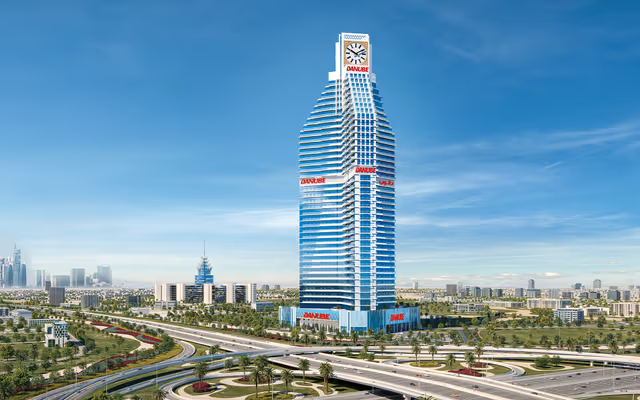
| Timez | 871,000 | ₹2.14 Cr |
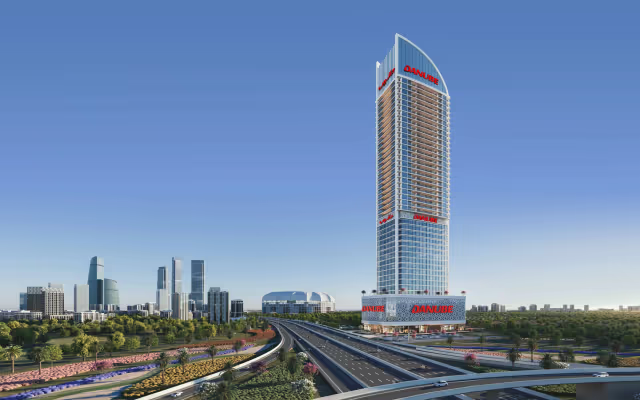
| Aspirz | 879,000 | ₹2.16 Cr |
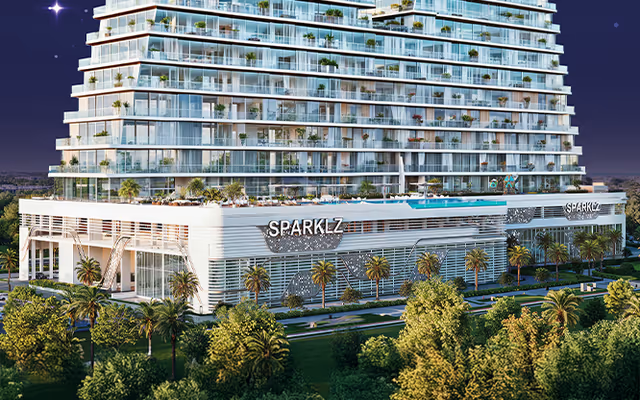
| Sparklz | 900,000 | ₹2.21 Cr |
This is why 2026 changed the conversation. Under the old rule these entry units cleared the AED 750K bar anyway — but the removal means every DLD-registered freehold residential unit, whatever its price, now carries visa potential for a sole owner, subject to government criteria. The question has moved from "is the flat expensive enough?" to "is the paperwork clean?"
Two practical notes. First, on a 1%-style plan, 1% of AED 871K is roughly ₹2.14 lakh a month (indicative) — that's the real monthly commitment to weigh against a tier-2 India EMI. Second, since the visa realistically lands at registration/handover (see FAQs), nearer-handover stock matters: Oceanz 3 (entry AED 1.2M ≈ ₹2.95 Cr) is Danube's nearest handover at Q1 2027. Full schedules side by side: /dubai/payment-plans/.
Getting the money there: LRS, TCS and the ₹10 lakh correction
Two India-side rules decide how smoothly your money travels.
LRS. Under RBI's Liberalised Remittance Scheme, every resident individual can send up to USD 250,000 per financial year abroad, and overseas property purchase is a permitted purpose. The limit is cumulative across all your banks. Family members who are co-owners of the property can each use their own limit — four co-owners can remit up to USD 1 million in a year. Anything above the cap needs prior RBI approval.
TCS — and a correction. Many sites still say tax collected at source starts at ₹7 lakh. The threshold was raised to ₹10 lakh from 1 April 2025. As the rules stand under the Income-tax Act: NIL TCS up to ₹10 lakh of LRS remittances per financial year, then 20% on the amount above ₹10 lakh, tracked against your PAN across banks.
Worked example: remit ₹1 crore in a financial year → TCS is 20% of ₹90 lakh = ₹18 lakh. Painful on cash flow, but it is fully claimable as credit in your ITR — a timing cost, not a real cost, if your tax affairs are in order.
Also non-negotiable: a foreign property must be disclosed in Schedule FA of your ITR (non-disclosure carries penalties under the Black Money Act), and rental income is taxable in India for residents, with DTAA credit. NRIs are a different case. Please run all of this past your CA before you remit a rupee.
What can go wrong — the honest list
We'd rather you hear this from us than discover it later.
- Oversupply is real. Around 100,000 units are scheduled for 2026 delivery and ~75,000 for 2027 (analyst reports, 2025-26), with 66% of the pipeline concentrated in studios and 1BRs across five districts — including JVC/JVT, Business Bay and Dubailand. Historically only ~48% of announced units deliver on time, which softens the flood but also means your own handover can slip.
- Price growth is decelerating. +22% in 2023, +18% in 2024, +13% in 2025. Buy for payment-plan affordability and rental yield, not for a repeat of 2023. Prefer nearer-handover projects where you can.
- Yields: look at net, not the brochure. Gross apartment yields ran roughly 6-8% in 2025 (market data, not our projection); after service charges and vacancy, net is typically around 4.5-6%.
- Currency cuts both ways. At ₹24.60/AED (Oct 2026, indicative), your rupee cost is fixed only on the day you remit. A weaker rupee raises your remaining instalments — though it also raises the ₹ value of your AED rent. Keep headroom in the budget.
- Rules change. April 2026 moved in buyers' favour; the next change may not. The visa is always subject to government criteria — buy a flat you would want even with no visa attached.
- Your protection: off-plan money goes only into the project's DLD-registered escrow account, released against construction milestones — and we never collect payments. Developer and DLD escrow only.
FAQs
Is there really no minimum property value for Dubai's 2-year investor visa now?
Yes — for sole owners. In April 2026 the Dubai Land Department removed the AED 750,000 minimum that applied earlier. If the freehold residential unit is registered with DLD in your sole name, there is no price floor. Joint owners still need a stake of at least AED 400,000 each (about ₹98.4 lakh at ₹24.60/AED, Oct 2026, indicative), and a mortgaged unit needs the bank's NOC. Be careful with older articles: a large share of the pages ranking for this query still quote AED 750,000, which was true before April 2026 and isn't anymore. And remember the standing caveat — ownership makes you eligible to apply; approval is subject to government criteria at the time of application, so confirm the current checklist with DLD/GDRFA.
Can I apply for the visa with an off-plan flat before handover?
Honest answer: don't plan on it. The 2-year investor visa requires a DLD-registered freehold residential property. Off-plan purchases are registered through Oqood, but guidance conflicts on whether Oqood-stage ownership qualifies for this visa or whether you need the title deed at handover — confirm the current position with DLD/GDRFA before building your timeline around it. (The 10-year Golden Visa is more settled here: off-plan is generally eligible, with the Oqood value counting, per practitioner guidance.) The practical approach is to treat the visa as a handover-stage milestone. If the visa timeline matters to you, weight your shortlist toward nearer-handover stock — Oceanz 3 (entry AED 1.2M, developer-published Oct 2026) is Danube's nearest handover at Q1 2027.
We're buying jointly as husband and wife — do we both get visas?
You may each be eligible, subject to government criteria, if each of you holds a stake of at least AED 400,000 in the DLD-registered property. On an AED 800,000 flat held 50:50, both of you sit exactly at the line — workable on paper, but confirm the documentation DLD/GDRFA expects before structuring it that tightly; a little buffer avoids arguments later. Joint purchase has a separate India-side advantage: under LRS, each resident co-owner can remit up to USD 250,000 per financial year, so a couple can move roughly double what one buyer can without touching RBI approval. Note the contrast with the Golden Visa, where your own share — not the total property value — must be at least AED 2 million.
Can I sponsor my family on the 2-year visa?
You may be able to sponsor your spouse and children once your own residence visa is issued — subject to government criteria, which involve documentation and eligibility conditions that change from time to time. We deliberately don't publish the requirement list here because it goes stale; confirm the current family-sponsorship rules with GDRFA when you apply. What we can say from the ground: the visa-plus-Emirates-ID combination is what makes Dubai usable as a second base — school admissions, local SIMs, tenancy contracts and UAE bank accounts all run off it. If the family plan matters more than the investment plan, say so on WhatsApp and we'll shortlist accordingly — a 1BR that rents well and a 2BR you'd actually live in are different purchases.
What does buying a Dubai flat do to my taxes in India?
Three things to put in front of your CA — and please do use a CA. First, the property must be disclosed in Schedule FA of your Indian ITR every year; non-disclosure carries penalties under the Black Money Act. Second, if you are an Indian tax resident, rental income from the Dubai flat is taxable in India, with credit available under the DTAA; NRIs are treated differently. Third, TCS on your remittance — NIL up to ₹10 lakh per financial year, 20% on the amount above that — is not a final tax; it is fully claimable as credit in your ITR. And a UAE residence visa by itself does not change your Indian tax residency. We are property consultants, not tax advisors — treat this as the agenda for your CA conversation, not as advice.
Should I stretch my budget to AED 2 million for the Golden Visa instead?
Only if the flat makes sense without the visa. The 10-year Golden Visa needs AED 2 million — about ₹4.92 crore at ₹24.60/AED (Oct 2026, indicative) — and your own share must cross that line if you buy jointly. That is more than double Danube's entry band (Timez at AED 871K, Aspirz at AED 879K, developer-published Oct 2026). Our view as consultants: visa tenure is a weak reason to double your exposure in a market where price growth is decelerating and 2026-27 supply is heavy. A cleaner path many buyers take: start with one entry-band unit on a monthly payment plan, and if Dubai works for you, a second purchase later can take your holdings past AED 2 million. Read our Golden Visa guide before deciding either way.
Do I have to live in Dubai to keep the 2-year visa?
UAE residence visas generally come with conditions on how long you can stay outside the country before the visa lapses, and these rules have changed more than once — so we won't quote a number that might be stale by the time you read this. Confirm the current stay-out limit for the property investor visa with GDRFA before you buy, especially if your plan is to hold the flat from Indore and visit occasionally. What we can tell you: plenty of Indian owners run exactly that model — tenant in the flat, property manager on the ground, one or two trips a year — and structure their travel around whatever the prevailing rule is. Build the visa around the property, not the property around the visa.
Projects this guide points to
Want the visa math for your exact budget?
WhatsApp us your budget and timeline — we'll send live Danube availability, the exact payment schedule, and a visa-document checklist. Developer prices; payments only to developer/DLD escrow. 10:00-19:00 IST.